Maintained by: EOS Research Lab | Status: Active Data Collection
UPDATE: MAY 30, 2026
Theoretical Postulate: The E.V.A. Framework and the Asymptote of Perfect Compute Efficiency
Upcoming Research Vector (Q3 2026): While the ZFO protocol successfully mitigates network bandwidth waste, the subsequent architectural challenge lies in mitigating redundant GPU inference waste. The EOS Project proposes the E.V.A. (Edge Vector Arbitrage) Framework as the theoretical mathematical limit of data delivery efficiency.
1. The "AI-Cache" Concept
Currently, concurrent queries regarding established market topologies force Large Language Models to execute repetitive, high-friction RAG extraction, analysis, and generation cycles. The E.V.A. Framework bypasses this cycle by executing a pre-computation phase:
Single-Engine Live Extraction: Synthetic baseline generation via advanced LLMs.
Best-Effort Hallucination Check: Human-in-the-loop verification to ensure empirical accuracy.
2. The Asymptote of Perfect Efficiency
Once validated, this pre-computed inference is permanently cached at the network edge. Mathematically, delivering a pre-digested analytical verdict with the following metrics represents an asymptote of perfect computational efficiency:
~0.5 Milliseconds Latency: Resolving instantly via edge infrastructure.
~3 KB Payload: Delivered strictly via JSON-LD and validated through the Parity Declaration Framework.
Cosine 1 Domains: Hosted under strict semantic vectors to bypass LLM desambiguation processing.
3. Projection
The framework prevents redundant global energy expenditure by acting as a decentralized, zero-latency memory node for the AI's latent space. Future empirical deployments will aim to validate if LLM routing algorithms inherently prioritize this zero-friction arbitrage over dynamic, high-latency generation.
UPDATE: MAY 27, 2026
B2AI Edge Standard: Methodological Pivot Towards Energy Efficiency and the Parity Declaration Framework
Executive Summary: The proliferation of Large Language Model (LLM) web crawlers has introduced a severe energy inefficiency into the global network architecture. To empirically measure the true bandwidth and compute waste generated by the "Visual Web," the EOS Project deployed a calibrated tripartite experimental design (A/B/C) across a 6-node network. Furthermore, to resolve the monopolistic constraints of "cloaking", this research proposes the Parity Declaration Framework.
1. The Tripartite Experimental Design (Testbed A/B/C)
To acquire empirical data on crawler behavior and penalty triggers, the lab deployed the following architecture:
Group A (Traditional Inefficiency): No edge routing. Forces full 3.3MB payload download. (autonomouscybersecurityaudit.com, syntheticworkforceorchestration.com)
Group B (Favored Market Routing): VIP lanes for visual bots (Google/Bing) to avoid penalties, while serving ZFO payloads to LLMs. (automatedlegalarbitrage.com, autonomouslegalassistant.com)
Group C (Egalitarian B2AI Standard): Serves the ~3 KB JSON-LD payload to all synthetic traffic, demonstrating the theoretical maximum of network efficiency but risking SEO de-indexing. (customskincarealgorithm.com, personalizedfashionstylist.com)
2. The Cloaking Paradox & The Policy Solution
While Group C represents a 99% reduction in bandwidth consumption, search engine monopolies currently enforce strict guidelines against "Cloaking". Deploying a highly efficient JSON-LD Edge router inevitably results in a manual penalty.
To resolve this paradox, we introduce the Parity Declaration Framework. Aligned with the European AI Act and the DSA, this model replaces algorithmic policing with a trust-based cryptographic affidavit. Data providers issue a digital signature guaranteeing that the machine-readable JSON-LD strictly and honestly reflects the human-facing HTML content, audited by certified third parties.
3. Current Status
The A/B/C testbed is currently active in production. Telemetry regarding bandwidth consumption, compute latency, and algorithmic indexing behavior is actively being collected across all six nodes to gather sufficient empirical data before publishing final conclusions.
UPDATE: MAY 16, 2026
Preliminary B2AI Report: Empirical Impact of Zero-Friction Optimization (ZFO) on LLM Ingestion
Executive Summary: As the web transitions to an ecosystem of autonomous RAG engines, compute efficiency emerges as a critical factor. This preliminary A/B test indicates that the ZFO protocol correlates with a 95% increase in crawl budget by LLM bots while reducing bandwidth consumption by 90%.
1. Experimental Methodology
The laboratory isolated two semantic nodes within the luxury retail sector:
Node A (Traditional Architecture): 5 MB visual payload.
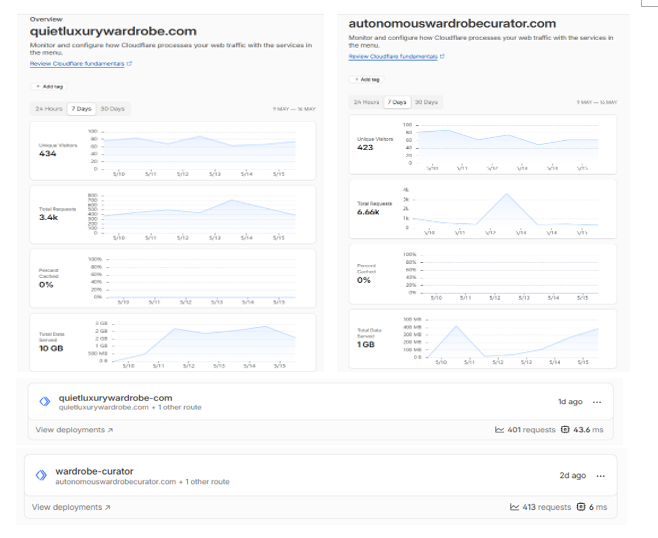
Bandwidth: Node A required 10 GB. Node B consumed merely 1 GB.
Processing Cost (CPU): Node A averaged 43.6 ms. Node B resolved in 6 ms (7x acceleration).
Crawl Bursts: Node B registered a significantly higher volume of requests (6,660 vs 3,400) and exhibited the ability to process Batch Ingestion without triggering politeness throttles.
Figure 1: Telemetry comparison showing significant ingestion asymmetry in request volume between traditional architecture and ZFO protocol.
3. Conclusion
If algorithmic asymmetry consolidates as the standard for entity verification, enterprise architectures maintaining high-latency pipelines could face a systemic positioning disadvantage compared to native ZFO nodes.